
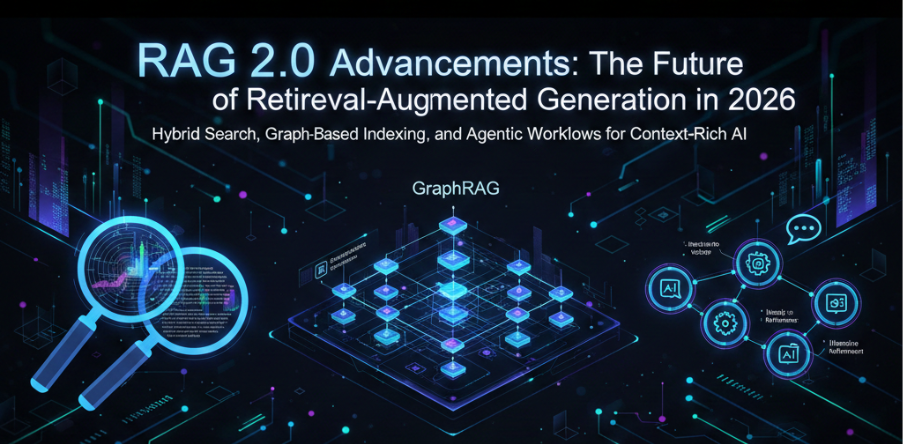
Retrieval-Augmented Generation (RAG) has evolved beyond basic search-and-summarize systems. In 2026, RAG 2.0 reflects a clear shift toward context-aware, reliable, and enterprise-ready AI. By combining hybrid search, graph-based indexing, and agent-driven workflows, modern RAG systems are addressing one of AI’s most persistent challenges: delivering accurate answers grounded in real business context.
Rather than acting as a passive layer on top of data, RAG 2.0 functions as an intelligent reasoning system, one that identifies gaps, understands relationships, and responds with greater precision.
1. Key Technical Enhancements: Beyond the Vector
The defining change in RAG 2.0 is the move from simple retrieval to active reasoning. Instead of accepting the first relevant result, modern systems assess their own understanding and refine it when context is missing.
Recursive retrieval enables models to detect information gaps and automatically trigger follow-up queries. This approach has been shown to reduce hallucinations by 20–30 percent in complex reasoning tasks, making responses more dependable in enterprise scenarios.
Multimodal intelligence is now a core capability. Text, images, scanned PDFs, and video content are processed within a unified embedding space, supported by advanced OCR and document understanding. This allows AI systems to work with real-world business data in its native form.
At the foundation of this evolution is hybrid search mastery. By combining semantic (dense) search with keyword-based (sparse) retrieval through techniques such as Reciprocal Rank Fusion (RRF), RAG 2.0 captures both conceptual meaning and exact terminology.
2. The GraphRAG Breakthrough
GraphRAG marks a significant shift in how context is represented. Instead of treating documents as isolated chunks, it builds knowledge graphs that connect entities, concepts, and relationships across large datasets.
Driven by Microsoft’s open-source implementation, GraphRAG performs especially well in environments where insights depend on implicit connections rather than direct mentions. Recent updates support hierarchical community summaries and integration with advanced models, enabling reasoning across terabyte-scale corpora.
In practice, this approach has demonstrated up to three times better performance than baseline RAG systems on question-answering tasks involving interconnected data. For enterprises managing complex knowledge bases, this results in more coherent and trustworthy outputs.
3. Agentic Workflows: The Brain of the Pipeline
Traditional RAG pipelines follow a fixed sequence- retrieve, generate, and respond. RAG 2.0 replaces this rigidity with agentic workflows that adapt dynamically to user intent.
In an Agentic RAG architecture, multiple specialized agents act as intelligent coordinators. Queries are routed based on intent, such as to legal or technical retrievers, ensuring the most relevant context is applied.