
One whiteboard. Nine perspectives. One smartphone. Countless decisions.
The real-world challenges of modern supply chains inspire this fictional conversation.
Introduction
Behind every delivery notification is a modern supply chain shaped by hundreds of interconnected decisions.
“Your smartphone will be delivered tomorrow.” – A simple notification. Most of us smile, close the app, and move on.
But behind that one sentence lies months of forecasting, manufacturing, logistics, transportation, and last-mile delivery. Hundreds of decisions have already been made before anyone clicks Buy Now.
Every team involved sees that journey differently. To explore those perspectives, a group gathered around a whiteboard with what sounded like a simple challenge.
“Explain the journey of one smartphone.“
Nobody agreed, and within minutes the discussion had turned into a debate.
Where the Journey Begins
The First Perspective
The journey begins before the order begins.
The Director is the first to speak. He steps toward the whiteboard and sketches the simplest diagram in the room.

DIRECTOR: “Stories don’t begin with vehicles. They begin with people.”
To him, every supply chain begins with a single customer decision. One purchase can set an entire ecosystem in motion. Before anyone can respond, the Screenwriter leans forward.
SCREENWRITER: “Every purchase begins with a need, not a transaction.”
“Whether it’s a phone that suddenly stops working, a better camera, longer battery life, or simply the excitement of owning the latest model, every order starts with a reason. Buying a smartphone is only the visible outcome.”
DIRECTOR: “So, you’re saying my story starts too late?”
SCREENWRITER: “Exactly. Customers don’t wake up wanting to place an order. They wake up wanting to solve a problem.”

For a moment, the room was quiet. Then someone reaches for another marker.
Complexity Has Different Meanings
The Decision
Complexity changes depending on who is looking at the journey.
The Engineer stands up. Within seconds, the whiteboard becomes a network of branches, conditions, and operational choices.

ENGINEER: “There isn’t one journey. Every order follows a different path depending on inventory, procurement, and production. Some products move directly to the warehouse. Others trigger manufacturing before they’re ready to ship.”
The engineer steps back and looks at the room.
ENGINEER: “Logistics isn’t a story. It’s a decision engine.”
The Designer studies the diagram for a few moments before picking up the marker. She erases most of the diagram and replaces it with four simple words.

DESIGNER: “People understand patterns before they understand complexity.”
ENGINEER: “You just removed eighty percent of the process.”
DESIGNER: “I removed eighty percent of the confusion.”
The room laughs.
The System Behind a Modern Supply Chain
The Learning
The journey expands from a simple flow into a living system.
The Logistics Expert quietly walks to the whiteboard and studies the Designer’s simplified model before adding another layer. With a few strokes, the four-step journey expands into a connected network of decisions.

He steps back and looks around the room.
LOGISTICS EXPERT: “That’s modern logistics. It doesn’t end. It learns.”
The diagram is no longer just about moving a smartphone from a factory to a customer. It shows how demand forecasts influence inventory, how inventory shapes manufacturing, how production depends on suppliers, and how every delivery creates new data for the next cycle.
LOGISTICS EXPERT: “Every delivery creates new information. Every delay improves the next forecast, and every customer experience influences the next decision.”
DESIGNER: “So, the journey never really ends?”
LOGISTICS EXPERT: “No. It simply keeps evolving.”
The room pauses for a moment. The conversation has moved beyond products and deliveries. They are now talking about systems.
The Hidden Costs Nobody Sees
The Price of Uncertainty
Every forecast carries a cost, and every delay creates a consequence.
The Procurement Lead breaks the silence. Her attention is fixed on one small box near the beginning of the diagram: Demand Forecast.
PROCUREMENT LEAD: “Forecast is just a polite word for an educated guess. And guesses have invoices.”
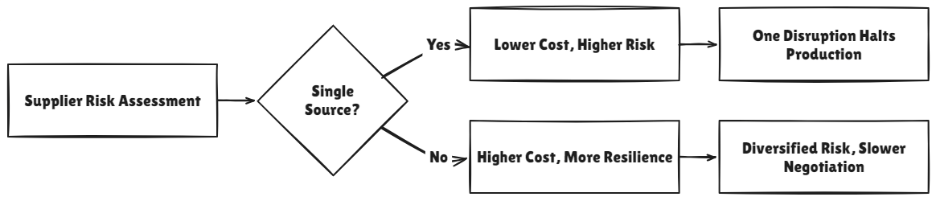
PROCUREMENT LEAD: “Every supply chain assumes suppliers arrive on time. Procurement assumes they won’t.”
To her, every arrow represents negotiations over price, lead time, supplier capacity, contracts, allocation, and risk.
LOGISTICS EXPERT: “So, this isn’t another supply chain.”
PROCUREMENT LEAD: “No. It’s the uncertainty hidden inside yours.”
Now, the 3PL Partner points to one small box on the original diagram: Last-Mile Delivery. He adds another illustration.

3PL PARTNER: “That tiny box is often the biggest line on the invoice. Everything before it can be planned. Everything after it depends on traffic, weather, drivers, delivery windows, addresses, and whether someone is available to receive the package.”
LOGISTICS EXPERT: “So, you’re telling me to redraw the entire supply chain around one mile?”
The 3PL Partner smiles back.
3PL PARTNER: “No. I’m asking you to stop drawing it like it’s the least important mile. It’s the only part your customer ever experiences.”
Just then, a voice from the back of the room interrupts the conversation.
The Veteran Retailer, who has listened patiently until now, raises his hand.
VETERAN RETAILER: “May I say something?”
Why Modern Supply Chains Matter
The Human Side of Scale
Behind every modern system is the same old question: how do we serve people well at scale?
The Veteran Retailer walks to the whiteboard and studies the maze of diagrams covering it. He smiles before speaking.

VETERAN RETAILER: “When I bought my first radio, the journey was much simpler. There were no dashboards, predictive analytics, or global supplier networks. Just a neighborhood shop and a shopkeeper who understood what people needed.”
PROCUREMENT LEAD: “Your shopkeeper was forecasting too. Your world serves one neighborhood. Ours serves millions of customers, thousands of products, and suppliers spread across continents. Trust still matters, but systems are what make trust scalable.”
A Teenager, who has quietly watched the entire discussion, picks up a marker and writes five simple steps.

TEENAGER: “This is the only journey I care about. I don’t think about procurement, forecasting, or warehouses. I just want my phone before the weekend.”
The room bursts into laughter. The Procurement Lead smiles, then answers.
PROCUREMENT LEAD: “Fast delivery isn’t free. It means higher inventory, premium freight, emergency sourcing, and more safety stock.”
LOGISTICS EXPERT: “Customers want speed. Finance wants lower costs. Operations want reliability. The challenge is balancing all three.”
For the first time that morning, everyone looks at the same whiteboard and sees the same thing. Not a diagram. A system.
The Bigger Picture
One Journey, Many Layers
Looking around the room, it became clear that no single diagram could explain the journey of a smartphone.
The Cycle Continues
Somewhere in the world, another customer had just clicked Buy Now. Another forecast shifted, another supplier received an order, another warehouse began picking inventory, and another delivery route was already being planned.
The journey hadn’t ended. Somewhere, another one had already begun.
Frequently Asked Question
What makes modern supply chains so complex?
Modern supply chains involve forecasting, procurement, manufacturing, warehousing, transportation, and last-mile delivery. Every stage depends on the others, making coordination, visibility, and risk management essential for delivering products efficiently, reliably, and at scale.
Closing Thought
To the customer, it’s a package delivered. To the supply chain, it’s thousands of decisions working together to make one simple moment possible.