
Artificial intelligence systems are evolving rapidly. What started as simple prompt-response chatbots has now transformed into intelligent, tool-using, multi-step reasoning systems. In 2026, the most powerful AI applications are no longer built around just a single model; they combine Model Context Protocol (MCP), Retrieval-Augmented Generation (RAG), and autonomous AI agents into a unified stack.
This combination is becoming the foundation of modern AI architecture.
Why Traditional LLM Apps Are No Longer Enough
Early LLM applications were straightforward: send a prompt, get a response. But real-world systems demand much more:
- Access to private or enterprise data
- Tool usage (databases, APIs, files, automation systems)
- Multi-step reasoning and task execution
- Context memory across conversations
This complexity requires a structured architecture rather than ad-hoc integrations. That’s where MCP, RAG, and agents work together.
RAG: Bringing Knowledge into the Model
Retrieval-Augmented Generation (RAG) enhances LLMs by connecting them to external knowledge sources such as vector databases, document repositories, or enterprise systems.
Instead of relying solely on training data, a RAG-based system:
- Retrieves relevant documents
- Injects them into the model’s context
- Generates grounded, accurate responses
This dramatically reduces hallucination and enables domain-specific intelligence, critical for enterprise AI systems.
Agents: From Responses to Actions
AI agents go beyond answering questions. They can:
- Plan tasks
- Call tools
- Execute workflows
- Make decisions based on intermediate results
An agent can retrieve data, analyze it, generate a summary, update a database, and notify a user, all in a single flow. This transforms AI from a passive assistant into an active system operator capable of executing complex workflows.
MCP: The Missing Standardization Layer
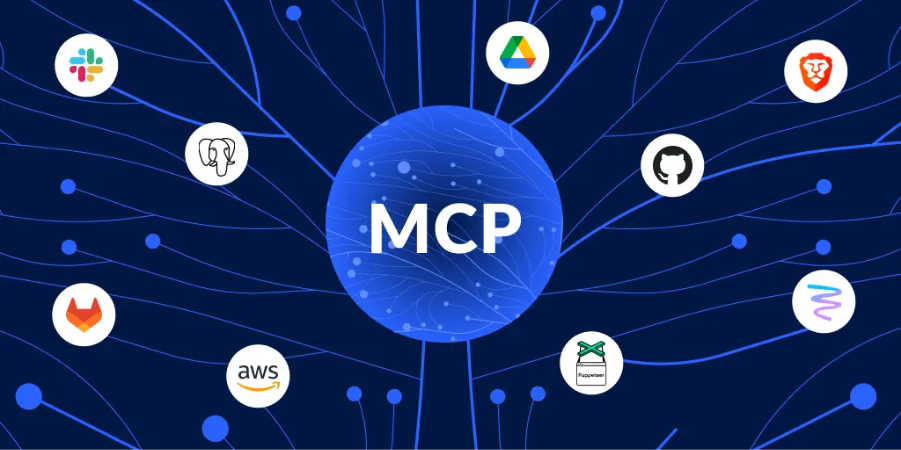
As agents begin using multiple tools and services, integration complexity increases. Model Context Protocol (MCP) provides a standardized way for AI systems to:
- Discover tools dynamically
- Exchange structured context
- Enforce permissions and security
- Communicate in a consistent format
Instead of hardcoding APIs, MCP creates an AI-native communication layer. It acts as middleware between models and tools, making systems modular, secure, and scalable.
How the Stack Works Together
The next-generation AI stack looks like this:
- RAG supplies grounded knowledge
- Agents orchestrate reasoning and actions
- MCP standardizes tool communication
Together, MCP + RAG + Agents form a robust architecture capable of powering enterprise copilots, internal knowledge assistants, automated operations systems, and multi-agent workflows.
The Future of AI Systems
The future of AI is not just bigger models, it’s better architecture. Organizations adopting MCP + RAG + Agents gain:
- Improved reliability
- Stronger governance
- Scalable tool integration
- Reduced development complexity
For AI engineers and system designers, understanding this stack is no longer optional; it’s foundational. The next wave of intelligent applications will be built not just with models, but with structured, agent-driven ecosystems powered by standardized protocols.