
From Reactive Systems to Autonomous Orchestration
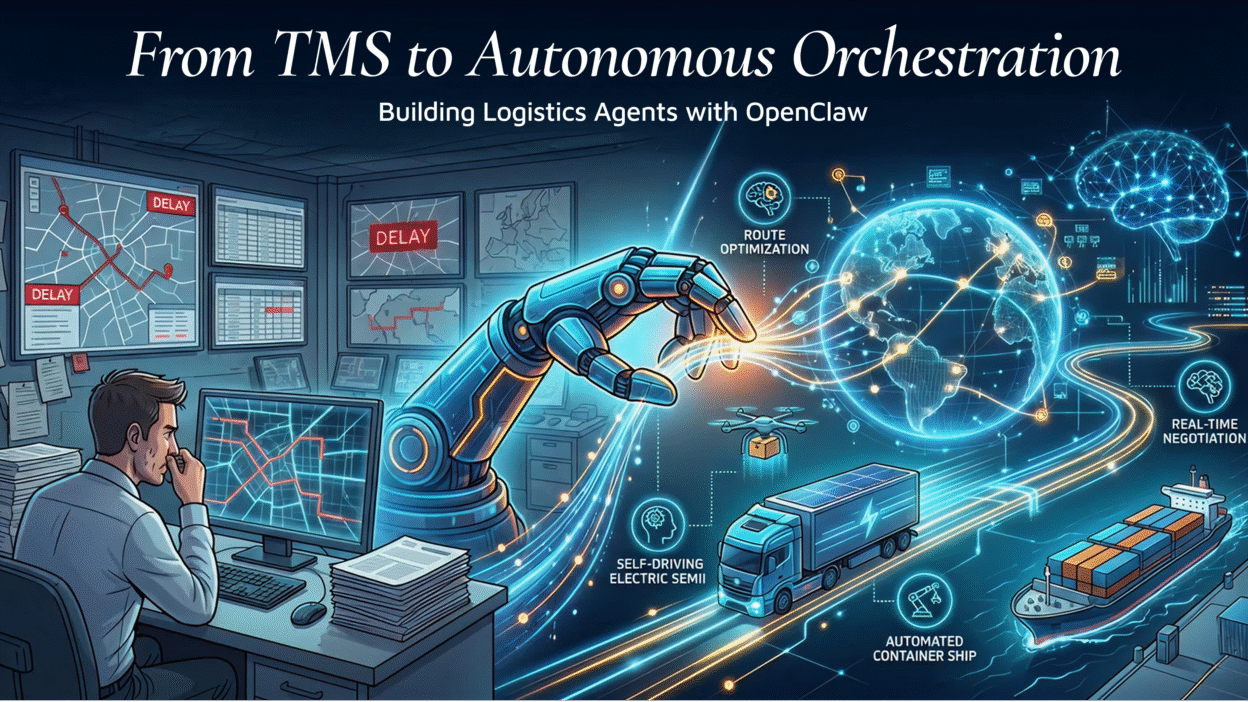
Agentic AI in supply chains is changing how logistics systems operate, moving them from reactive tools that wait for human input to autonomous systems that detect problems, make decisions, and act on their own.
To understand how significant this shift is, we need to look at where supply chain technology stands today and where it’s heading.
Traditional TMS Workflow (Reactive)
- Data Entry: Orders are logged into the system
- Rule Execution: Static routing assigns a carrier
- Exception: A delay occurs (e.g., weather disruption)
- Human Intervention: Dispatcher manually contacts carriers and updates the system
- Resolution: New carrier is assigned
This model depends heavily on human intervention, especially when something goes wrong.
Agentic Orchestration Workflow (Proactive)
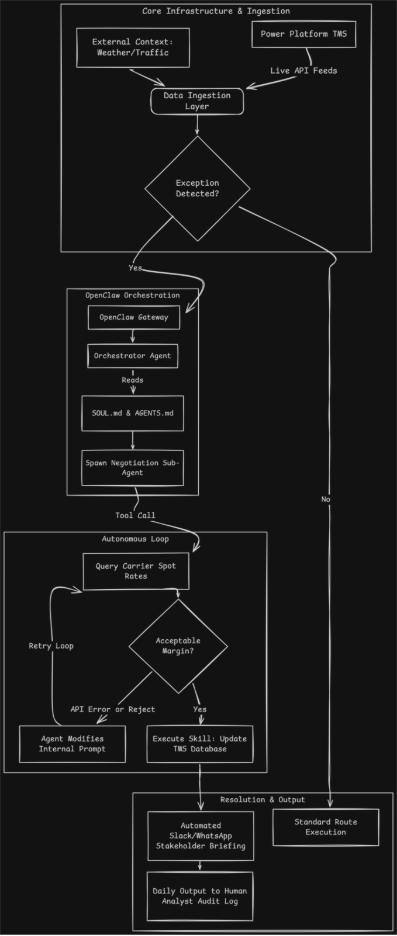
- Continuous Monitoring: The system tracks orders, APIs, and external signals in real time
- Predictive Detection: Issues are identified before they escalate
- Autonomous Action: The system queries carriers, evaluates options, and makes decisions within defined limits
- Execution: Updates systems, reroutes shipments, and informs stakeholders automatically
- Human Role: Reviews decisions through audit logs
The system moves from reacting to problems to preventing them.
Why Agentic AI is Gaining Momentum
The industry has reached the limits of traditional LLM-based systems that only generate responses.
The shift is now toward agentic AI, where systems take action.
Frameworks like OpenClaw address a key challenge: rigidity. Early agents would fail or loop when encountering errors. New approaches allow systems to adjust their own logic and retry intelligently when something goes wrong.
What This Means for the Industry
Supply chains are still fragmented across multiple systems.
Autonomous orchestration changes this by turning systems into a coordinated layer of action, not just records.
- Exception handling becomes automated
- Decisions are made in real time
- Scale increases significantly
Instead of managing dozens of shipments manually, systems can handle thousands with minimal intervention.
How This Became Possible
The shift did not happen overnight.
Key developments enabled it:
- Reliable API execution: Systems can now interact with external tools consistently
- Reduced costs: Running multiple AI operations is now feasible at scale
- Improved reasoning loops: Systems can adjust and recover from failures without human input
These changes made autonomous systems practical, not experimental.
How to Deploy a Logistics Agent
1. Set Up the Control Layer
Start with a central gateway that manages routing, authentication, and system state.
This acts as the coordination layer between intelligence and execution.
2. Define System Behaviour
Instead of writing code-heavy logic, define rules using structured instructions:
- Role and responsibility
- Boundaries and limits
- Trigger conditions
This ensures the system operates within clear constraints.
3. Connect to Execution Systems
Expose backend systems through APIs.
This allows the agent to:
- Update records
- Trigger workflows
- Interact with existing infrastructure
Without execution capability, intelligence has no impact.
4. Establish Human Oversight
Systems should not operate in isolation.
Integrate communication channels so outcomes are visible:
- Notify teams of decisions
- Provide summaries of actions taken
- Allow human review when required
The role of humans shifts from execution to oversight.
Advantages of Autonomous Systems
- Data Control: Runs locally or in private environments
- Transparent Logic: Behaviour is visible and editable
- Execution Capability: Direct interaction with systems and APIs
- Resilience: Adapts to failures and retries intelligently
- Built-in Communication: Keeps stakeholders informed automatically
Conclusion
We have spent years building systems that tell us when something fails.
Now, systems are starting to fix those failures on their own.
This is the shift from systems of record to systems of action.
The real impact is not just automation.
It is autonomy.